

Choosing the Right Diamond
15 April 2025
Walking into a jewelry store to buy an engagement ring or a diamond necklace can feel intimidating. Many clients tell us they don’t know much about diamonds and worry about making the wrong choice. We’re here to guide you. If you’re hesitating between two pieces, this article will help you better understand what influences the value and price of diamonds.
The 4Cs: how to evaluate a diamond’s value
Whether natural or lab-grown, diamonds are always evaluated using the same criteria: the 4Cs—Cut, Clarity, Color, and Carat weight. These factors determine not only a diamond’s quality, but also its uniqueness. Let’s explore these four essential characteristics.
Cut: the art of capturing light
The only characteristic shaped by human hands, cut is likely the most important factor. It is what gives a diamond its brilliance and radiance. A precise cut is essential to reveal its full sparkle.
In the earliest times, people wore rough diamonds, believing they would lose their protective powers if altered. During the Middle Ages, diamonds began to be polished to enhance their shine without changing their shape. It wasn’t until the 15th century that cutting diamonds with other diamonds was discovered.
Early cuts were very simple, with few facets. Over time, they became increasingly complex, featuring a growing number of facets. This craftsmanship reached its peak with the “brilliant cut,” developed in the early 20th century. Its 58 facets allow light to enhance the diamond’s beauty. Today, it is the most common shape, about 75% of diamonds sold are cut this way.
Other popular shapes include princess, emerald, pear, and marquise cuts. There are, however, hundreds of variations.
Here are some pieces set with diamonds of different shapes that you can find at La Perle Rare.


Clarity: the identity of the diamond
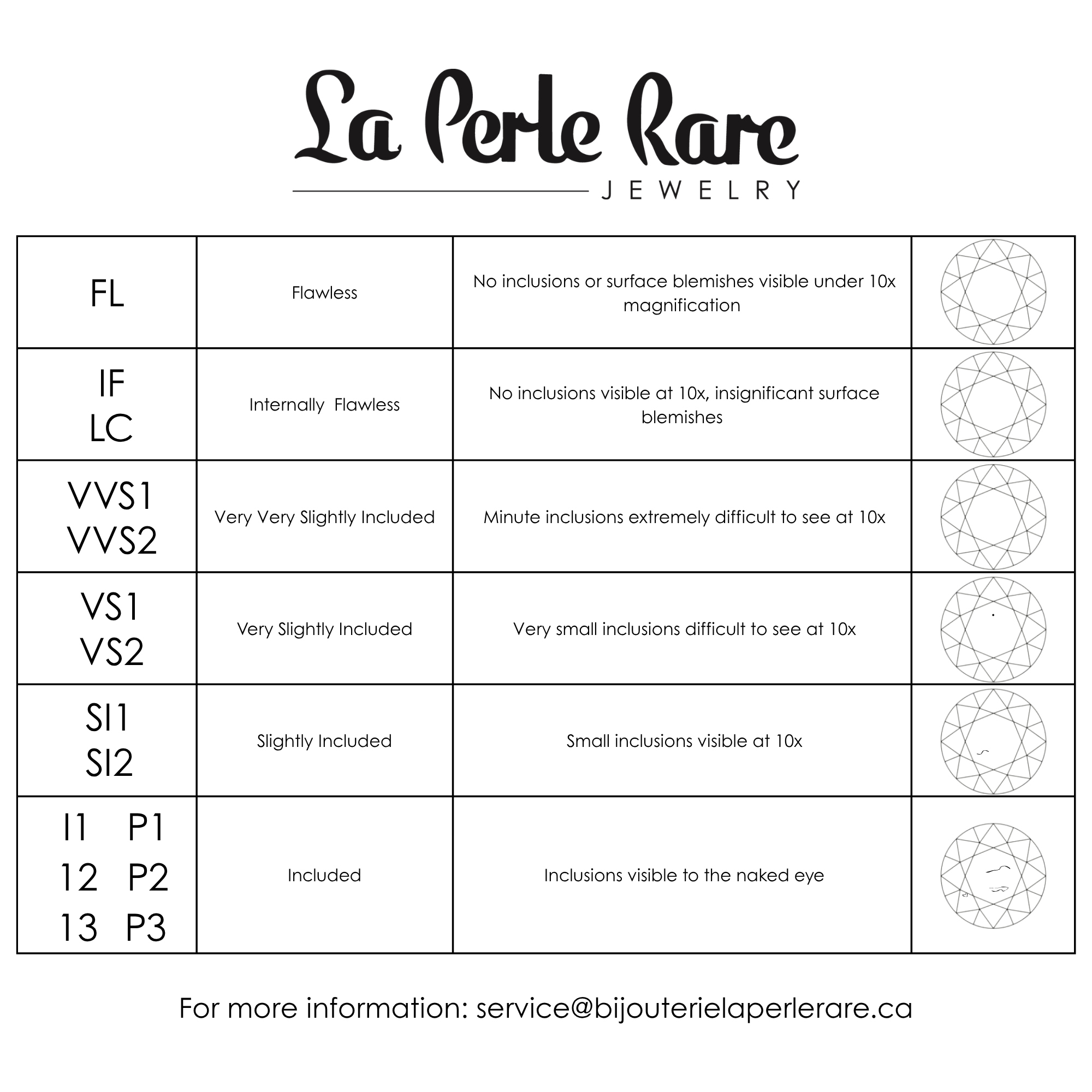
Every diamond, whether natural or lab-grown, contains internal characteristics called inclusions. These form the unique identity of each stone.
Depending on their number and location, inclusions affect how light reflects and travels through the diamond, influencing its brilliance. Clarity is evaluated using magnification. Below is a chart showing the clarity grading scale.
Color: a spectrum of possibilities
Although diamonds can be found in a variety of shades, the most common are colorless or slightly tinted yellow. Their color is graded on a scale from D (exceptionally white) to Z (noticeable tint).
Colored diamonds are graded differently and fall under the category of “Fancy Colored Diamonds.” They exist in a wide range of colors: blue, pink, red, green, and more. These stones are rare, sometimes even rarer than perfectly colorless diamonds.
Some, such as red diamonds, are extremely rare (only a handful exist worldwide) and can be worth millions of dollars per carat.
Black diamonds are an exception and are generally more affordable.


Carat: a unit of weight
A diamond’s weight is measured in carats. The word “carat” is believed to come from the carob tree, whose seeds,known for their consistent weight, were once used to weigh gemstones.
One carat equals 0.2 grams and is divided into 100 points.
Large diamonds are extremely rare. It is estimated that about 20% of diamonds weigh more than 20 points, while only 5% exceed one carat. This is why, with equal cut, clarity, and color, a single 2-carat diamond is more valuable than two 1-carat diamonds.

Natural or lab-grown
As mentioned in our previous article, a diamond’s origin also has a strong influence on its price. Natural diamonds, formed millions of years ago and mined from the earth, are relatively rare.
Lab-grown diamonds, on the other hand, can be produced on demand and will become increasingly common on the market. The law of supply and demand therefore makes lab-grown diamonds more affordable than mined diamonds.
Here are two rings set with one carat (100 points) of diamonds. One features natural Canadian diamonds, while the other uses lab-grown stones. Both pieces are beautiful, but one is significantly more accessible.
A diamond that reflects you
You now know more about diamonds and the criteria that determine their value. There is no right or wrong choice, it all comes down to personal taste, ethical values, and budget.
Simply remember: nothing is more beautiful than a diamond that reflects your story,whether it’s one passed down from your grandmother, the stone set in an engagement ring, or the diamonds that marked a meaningful moment in your life.
To create even more lasting memories, we invite you to visit us in store or explore our online boutique.
Sources : Wikipédia, Diamants Infos